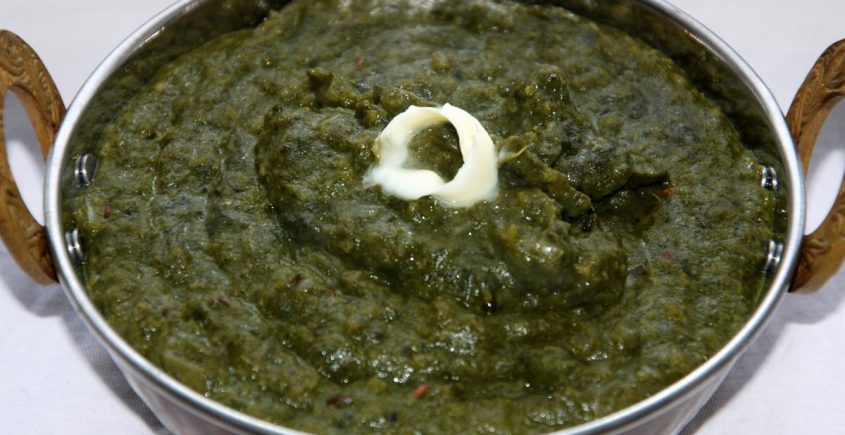

Sarson ka saag is the winter dish of Punjab. Mustard greens are cooked slowly with spinach and a few bathua leaves, mashed with a wooden masher (ghotni) and a little maize flour, then finished with a tadka of ghee, garlic and green chillies. It is eaten with makki ki roti, a dollop of white butter and a glass of lassi.
Mustard greens are in the markets from November to February. They can taste bitter on their own, which is why they are mixed with spinach. The long cooking softens both the leaves and the bitterness, so do not rush it.
Mustard greens are naturally bitter, especially older leaves. Mix them with spinach, cook them slowly until very soft, and a little jaggery or extra ghee will balance the taste.
Maize flour thickens the saag and gives it its classic taste. You can use a tablespoon of gram flour instead, but the flavour will be different.
Bathua (chenopodium) is a leafy green found in winter. It adds a slightly sour, earthy taste. If you cannot find it, use more spinach.
Photo: Sarson-Ka-Saag by Officialksv, CC BY-SA 4.0, via Wikimedia Commons
Wash the greens very well in several changes of water, because mustard leaves hold a lot of grit. Chop them roughly.
Put the greens, green chillies, ginger, garlic, salt and water in a large pot. Cover and cook on low heat for 45 minutes to 1 hour, stirring now and then, until very soft. (Or pressure cook for 10 to 12 minutes.)
Mash the greens with a wooden masher, or pulse them in a blender a few times. Do not make a smooth puree; saag should keep some texture.
Put the pot back on low heat. Sprinkle in the maize flour while stirring, then cook for 15 to 20 minutes, stirring often, until the saag is thick and glossy and the raw flour taste is gone.
For the tadka, heat the ghee in a small pan. Fry the onion until golden, then add the garlic, ginger and green chillies and cook for 1 minute. Add the chilli powder if using.
Pour the tadka over the saag and mix. Serve hot with makki ki roti, a spoonful of white butter on top and a piece of jaggery on the side.
Pick tender mustard leaves. Older leaves with thick stems are more bitter and fibrous.
Saag keeps for 4 to 5 days in the fridge and tastes better the next day. It also freezes well, so you can make a big batch in season.
If the saag tastes too bitter, add a little more spinach or a small piece of jaggery.
Fresh white butter is traditional, but a spoon of ghee works too.
Rubina Shaukat is a professional chef who teaches cooking at a government technical college in Pakistan. She manages IngRecipe, sharing recipes and practical guides to ingredients and kitchen basics for home cooks. She also runs the Home Ingrecipe kitchen in Multan.
Read More